THE CONSTITUTION OF THE PLANE PRECEDES THE MOTION WITHIN IT
The eye—or more precisely, the visual system as interface—does not passively sample photons. It actively scaffolds a workable manifold.
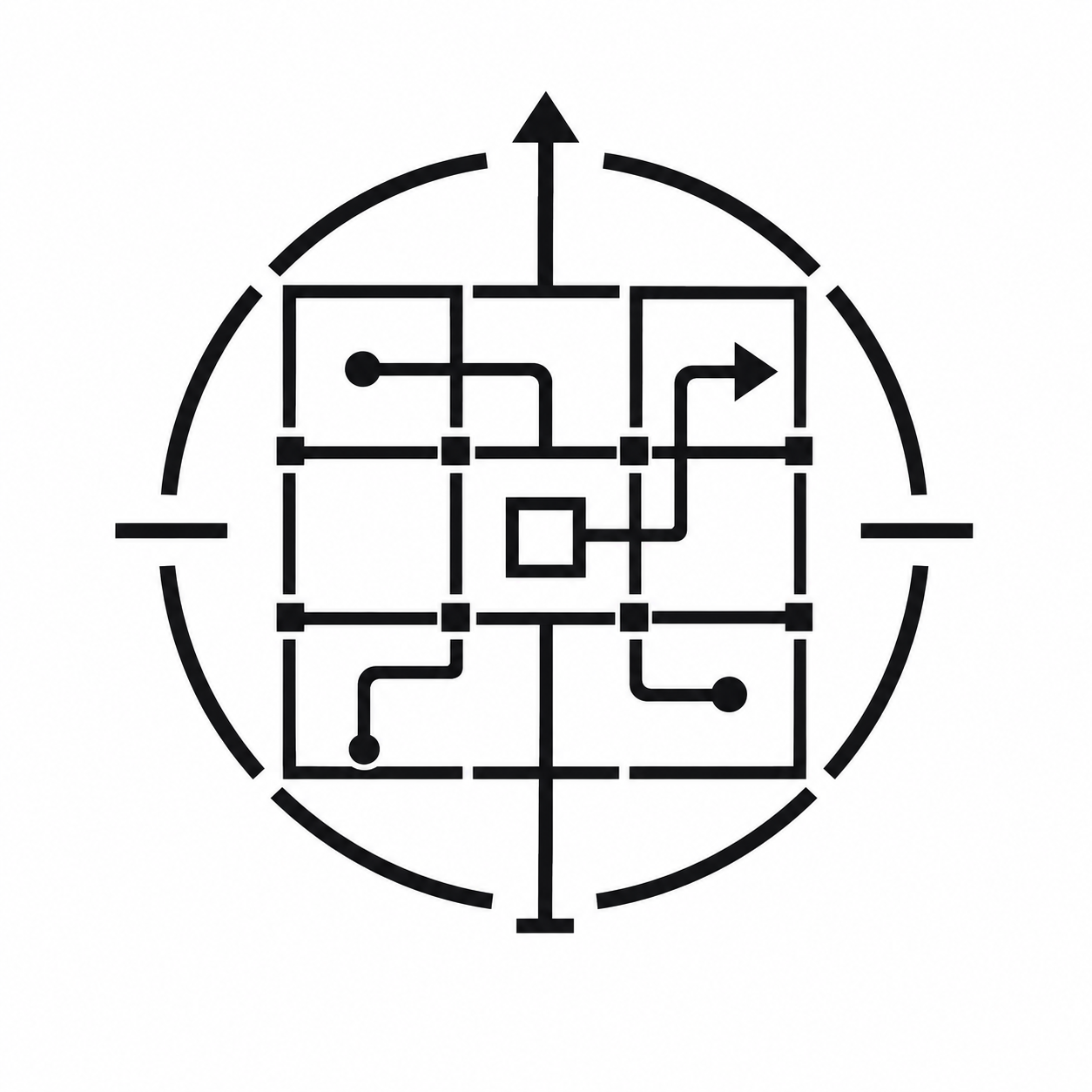
Before a saccade, pursuit, or deliberate action becomes useful, the visual system must register three kinds of relation:
Marks
Salient anchors from which the field may be oriented: using football as as example, the strong safety’s alignment, the hash marks, the receiver’s split.
Witnesses
Relational validators that confirm or falsify the emerging structure: the linebackers’ leverage, the defensive front, or the quarterback’s own offensive line acting as a mobile boundary condition.
Field invariants
The compressible rules that remain operative across the field: gravity, field dimensions, down and distance, and the clock, together with the higher-order invariants of the specific play—its route concept, protection scheme, and admissible transformations.
This is plane constitution: the reduction of an underdetermined sensory stream into a low-entropy operational geometry within which trajectories become computable.
Tom Brady’s particular intelligence was temporal. Before the snap he had already run a compressed forward model of the field. The visual system performs a related operation continuously, typically through several saccades per second: the fovea acts as a high-resolution probe while peripheral vision monitors relation, motion, and drift.
The football field is one embodied example of a more general principle. Before action can become intelligible, a field must be constituted strongly enough to distinguish position from movement, signal from variation, and continuity from divergence.
EMS Correspondence
In Encoded Material Systems terms:
The Gamecraft Plane is the constituted field within which motion and consequence become possible.
Marks and witnesses operate as Basecell anchors and lineage proofs—orbs, threads, glyphs—through which orientation and relational continuity may be verified.
Invariant relationships are compressive protocols that survive revision. They prevent narrative, material, and structural drift without preventing admissible transformation.
The manifold of possibilities is resolved through processes such as the APERTURE → REGISTRO pipeline or the parallax-knot ontology: ambiguity is not merely eliminated but collapsed into an auditable geometry.
The throw—or any subsequent action—is downstream execution. Much of the intelligence lies in the prior constitution of the field and in its continuous refinement as new observations arrive.
Divergence detection asks whether reality continues to satisfy the operative constitution. It is the anti-drift mechanism in embodied form.
A weakly constituted field traps the participant in immediate action, forcing frame-by-frame reaction. A strongly constituted field permits action from the perspective of the plane itself, preserving spare capacity for anticipation, comparison, and adjustment.
Mathematical Sketch
Within an affine plane, three non-collinear points may establish an affine frame. Equivalent constructions may be produced through other sufficient combinations of points, lines, and incidence relations. Once the frame is established, transformations can be evaluated according to what they preserve. In projective vision, for example, invariants such as the cross-ratio allow certain relations to remain recoverable despite changes in viewpoint.
The visual system solves a substantially harder problem. It receives noisy, moving, and partially occluded observations, combines them with priors established through memory and previous constitutions, and produces a best-consistent field together with a bundle of probable trajectories.
A quarterback performs this operation across twenty-two dynamic agents, a bounded surface, and a governing ruleset. The eye performs it across an immense sensory field through cortical systems responsive to edges, depth, motion, faces, hands, and higher-order social relations.
In neither case is observation merely reception. Observation participates in the constitution of the field.
The Visual Interface
This is why visual interfaces—eyes, diagrams, dashboards, maps, or constructed aesthetic fields—are powerful. They externalize and stabilize the work of plane-making.
Cliff compressions, terraced shadows, resonant waves, boundaries, contrasts, and repeated forms do more than ornament a surface. They may establish anchors, expose relations, preserve orientation, and make divergence perceptible.
A well-constituted visual field does not merely display information. It produces the conditions under which better operational geometry can form.
Continuous Constitution
The plane is constituted before motion becomes intelligible, but it is not constituted only once.
Every observation tests the field against its marks, witnesses, and invariants. Where correspondence holds, action may continue. Where divergence appears, the field must refine, return, or be constituted again.
The constitution precedes the motion.
Observation keeps it true.